
Understanding how fishing rod action works is one of the single most effective ways to improve your casting accuracy, bait presentation, and hook-up ratios. Whether you are targeting carp on commercial fisheries, roving along riverbanks for chub, or casting lures off UK coastlines, your choice of rod action dramatically influences how your gear performs.
This guide breaks down everything you need to know about rod actions in plain English, helping anglers of all experience levels select the ideal kit for their next session.
What Is Fishing Rod Action?
In angling terminology, "action" refers to where along the blank a fishing rod bends when pressure is applied to the tip. It also describes how quickly the rod tip recovers and springs back to its original straight position after being loaded during a cast or hookset.
It is common to confuse rod action with rod power, but the two are entirely distinct features:
- Rod Action: Describes where and how fast the rod bends (e.g., Fast, Moderate, Slow).
- Rod Power: Describes the rod's overall resistance to bending and its lifting strength (e.g., Light, Medium, Heavy).
Knowing the difference ensures you choose a rod blank that pairs correctly with your chosen line, rig, and target fish species.
The Three Primary Types of Rod Action
Fishing rods generally fall into three core categories: Fast Action, Moderate (or Medium) Action, and Slow (or Through) Action. Each style offers unique advantages depending on your technique and venue.
Fast Action Rods
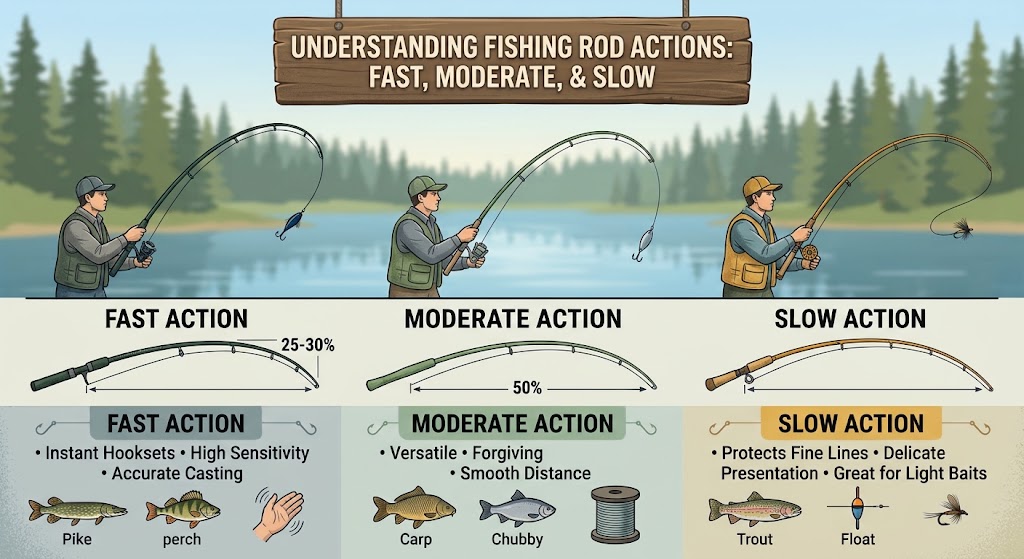
A fast action rod bends primarily in the top 25% to 30% of the blank, near the tip section. Because the remaining bottom portion of the rod stays rigid, it responds exceptionally quickly when you pull back on the line.
Key Characteristics:
- Instant Hooksets: Ideal for penetrating hard mouths when lure fishing for pike or perch.
- Superior Sensitivity: Transmits subtle bites and underwater features directly to your hand.
- Casting Power: Great for punching heavier weights into strong head-winds.
Moderate Action Rods
Moderate action rods (often called medium action) bend along the top 50% of the blank. They offer a balanced compromise between the stiffness of a fast rod and the soft flexibility of a slow rod.
Key Characteristics:
- Versatility: Performs well with a wide range of casting weights and fishing styles.
- Forgiving Cushion: Absorbs sudden head-shakes and violent lunges from fighting fish.
- Smooth Distance: Loads progressively during the cast, making long-range casting effortless.
Slow Action (Through Action) Rods
Slow action rods bend gradually throughout the entire length of the blank, right down to the handle. In traditional UK coarse fishing, these are frequently referred to as "through-action" or "full-flex" rods.
Key Characteristics:
- Maximum Protection: Cushions light hooklinks and fine lines against sudden snaps.
- Fun Playability: Provides maximum enjoyment and feel when playing fish of any size.
- Delicate Casting: Perfect for casting light baits, surface float setups, or delicate flies.
Practical Tips
- Match Your Technique: Use fast action rods for single-hook lure techniques and moderate or slow action rods when using treble hooks or light line setups.
- Adjust Your Cast: Allow slow and moderate rods extra time to "load" on the back-cast rather than rushing the stroke.
- Inspect the Bend: Test a new rod by holding the grip and having a friend gently pull down on the tip to observe where the curve starts.
Common Mistakes
- Confusing Action with Power: Purchasing a "heavy power" rod expecting it to have a fast tip, or buying a "light power" rod assuming it will bend through to the butt.
- Using Fast Action with Fine Lines: Striking hard on a fast action rod while using light hooklinks can easily snap your main line or pull hooks free.
- Rushing the Cast on Slow Blanks: Whip-casting a slow action rod too quickly reduces your casting distance and can cause line tangles around tip rings.
Frequently Asked Questions
What is the difference between rod action and rod power?
Rod action describes where along the blank the rod bends and how fast it recovers. Rod power refers to the rod's strength and resistance to bending under a heavy load.
Is a fast action rod better for lure fishing?
Yes, fast action rods are excellent for lure fishing because their sensitive tips detect soft takes quickly, and the stiff backbone allows for immediate hooksets.
What action is best for coarse and carp fishing?
Moderate and progressive slow action rods are widely favoured for coarse and carp angling, as they absorb powerful runs under the rod tip and prevent hook pulls.
Can beginners start with a moderate action rod?
Absolutely. Moderate action rods are highly versatile and forgiving, making them the ideal starting point for anglers learning casting techniques.
Conclusion
Understanding fishing rod action empowers you to choose the exact tool required for your style of fishing, improving both your comfort on the bank and your overall catch rate. Whether you need the quick sensitivity of a fast action tip or the forgiving cushion of a through-action blank, matching your rod to your tactics makes every session more rewarding.
To explore more expert guides, rigging tips, and tackle insights, continue exploring the Procastangling.com blog!