
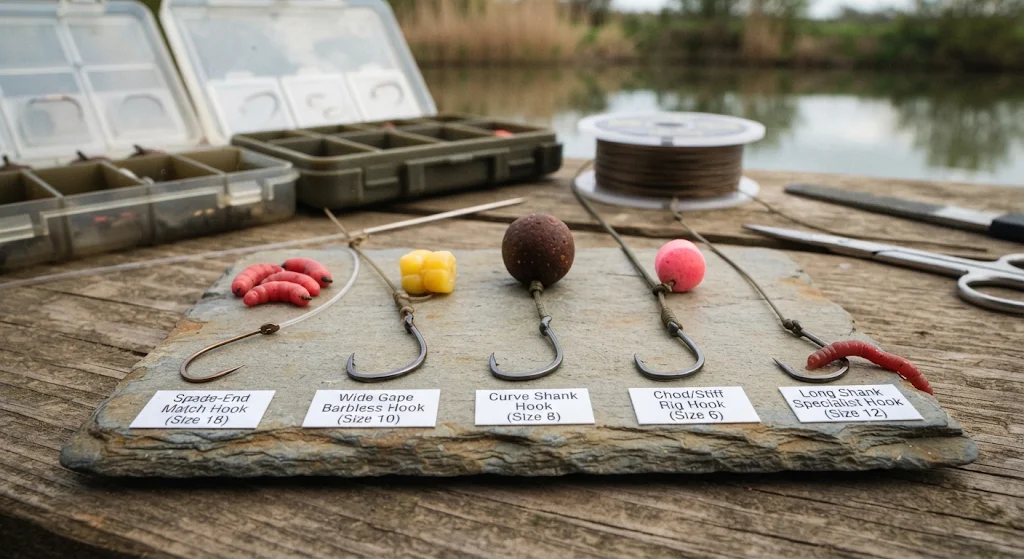
Choosing the right hook pattern is one of the most important decisions you will make on the bank, yet it is often overlooked in favour of rods, reels, and bait. Your hook is the single point of contact between you and the fish, meaning a slight change in shape, wire gauge, or eye angle can dramatically affect your catch rate.
Whether you are targeting cautious carp on a pressured commercial fishery, trotting for grayling on a fast-flowing river, or ledgering for tench at dawn, matching your hook to your bait and rig is essential. In this guide, we will break down hook anatomy, popular UK hook patterns, and practical advice to help you land more fish with confidence.
Understanding the Anatomy of a Fishing Hook
Before comparing different shapes, it helps to understand the basic parts of a hook and how each feature influences performance. Knowing what to look for makes selecting patterns in the tackle shop far easier.
The Eye: In-Turned, Out-Turned, or Straight
The eye is where you tie your hooklength, and its angle dictates how the hook flips and turns inside a fish’s mouth.
- In-turned eyes angle slightly towards the hook point, encouraging the hook to aggressively turn and take hold in the bottom lip when the line tightens.
- Out-turned eyes tilt away from the point, making them ideal for stiff hooklink materials like fluorocarbon or chod filaments, as they preserve the hook's natural gape.
- Straight eyes sit inline with the shank and offer a balanced, versatile presentation suited to supple braids and traditional monofilament rigs.
The Shank, Gape, and Bend
The Shank is the straight section running from the eye to the bend. Long-shank hooks turn quickly and are difficult for a fish to eject, while short-shank patterns offer superior strength and discreet presentation for bottom baits.
The Gape is the distance between the point and the shank. A wider gape provides a larger bite area, ensuring the point clears bulky baits like boilies or sweetcorn to find a secure hold.
Point Shape and Wire Gauge
Hook points generally come in two styles: straight points and beaked (in-turned) points. Straight points penetrate rapidly upon contact, making them superb for clear lakes and soft-mouthed species, whereas beaked points stay sharper for longer when fishing over abrasive gravel bars or rocky riverbeds.
Wire gauge refers to the thickness of the steel. Fine-wire hooks are lightweight and delicate, allowing natural presentation with maggots or casters, while heavy-gauge forged hooks provide the backbone needed to steer hard-fighting carp away from snags.
Popular UK Hook Patterns and When to Use Them
UK coarse, match, and specimen anglers have access to dozens of specialised patterns. Understanding the strengths of the core designs will cover almost every freshwater scenario you are likely to encounter.
Wide Gape Hooks
The wide gape is arguably the most versatile pattern in modern UK carp and specimen angling. Featuring a short shank, a broad bend, and usually a subtly beaked point, it excels with bottom baits, wafters, and snowman presentations. Its compact profile makes it easy to mask, while the generous gape guarantees a deep, reliable hook-hold.
Curve Shank Hooks
Curve shank patterns feature a sweeping, curved shank and an in-turned eye that creates an aggressive hooking mechanic without needing extra shrink tube or line aligners. As a fish sucks in the bait and blows it out, the curve forces the hook to rotate rapidly into the bottom lip. They are outstanding for bottom baits and wafters over clean silt or gravel, though they should be used carefully in heavy weed where excessive leverage can widen the hook hole.
Chod and Stiff-Rig Hooks
Designed specifically for pop-up presentations, chod hooks feature an out-turned eye that allows stiff mono or fluorocarbon to exit cleanly without closing down the gape. Whether tied onto a hinged stiff rig or a helicopter chod setup, this pattern ensures your pop-up sits at the optimal angle above low-lying weed or debris.
Spade-End and Fine-Wire Match Hooks
For match and silverfish anglers using poles, whips, or running line tactics, spade-end hooks are a staple. Instead of a looped eye, the top of the shank is flattened into a small spade, allowing the line to exit cleanly inline with the shaft. Paired with fine-wire construction, these patterns keep delicate baits like pinkies, squatts, and bloodworm lively and natural.
Barbed vs Barbless Patterns
Most UK commercial fisheries enforce strict barbless-only rules to protect fish welfare and speed up unhooking. Barbless hooks penetrate with less pressure than barbed equivalents, though maintaining steady rod tension during the fight is vital to prevent the hook from slipping. On venues or rivers where micro-barbed hooks are permitted, the tiny barb offers extra security when playing fish in fast currents or near snags.
Matching Your Hook to Bait and Fishing Style
Selecting a pattern becomes second nature once you base your choice on bait buoyancy, size, and venue rules.
- Maggots, Casters, and Worms: Opt for fine-wire, round-bend, or crystal-bend hooks in sizes 16 to 22. Avoid thick wire that bursts delicate baits and ruins their natural fall through the water.
- Boilies and Wafters: Choose a wide gape or curve shank pattern in sizes 4 to 8, ensuring the gape is wide enough to sit proud of the bait on a hair rig.
- Pop-Ups: Use an out-turned eye chod hook so stiff hooklink materials do not restrict the hook's movement.
- Pellets and Sweetcorn: A medium-wire wide gape or Pellet Waggler pattern in sizes 10 to 16 handles the weight of banded pellets or hair-rigged corn without straightening under pressure.
- Bread Flake and Paste: Longer-shank, wide-gape hooks provide extra room to mould soft paste around the shank while leaving the point exposed.
Practical Tips
- Check hook sharpness before every cast: Run the point gently across your thumbnail; if it slides smoothly instead of catching immediately, replace the hook or touch it up with a fine hook file.
- Match hook size to the bait, not the fish: A size 8 hook can easily land a 20lb carp if your rig mechanics are right, whereas an oversized hook often spooks cautious fish.
- Keep a small selection of proven patterns: Carry three or four reliable styles—such as a wide gape, a curve shank, a chod pattern, and a fine-wire match hook—in varying sizes rather than dozens of unfamiliar designs.
- Use a silicone kicker or line aligner on straight-eyed hooks: Adding a short sleeve over the eye mimics the aggressive turning angle of a curve shank when fishing bottom baits.
- Store hooks in dedicated, dry boxes: Moisture causes rust and dulls razor-sharp points rapidly, so keep spare packets sealed and dry inside your tackle bag.
Common Mistakes
Using Overly Heavy Wire for Delicate Baits
Many beginners assume thicker hooks are always better because they are less likely to bend. However, heavy-gauge hooks weigh down maggots, casters, and floating bread, causing them to sink unnaturally and resulting in far fewer bites. Always balance wire thickness with the weight of your bait and the strength of your mainline.
Masking the Hook Point
Burying the hook point deep inside sweetcorn, luncheon meat, or pellets prevents the hook from pricking the fish when it takes the bait. Even when side-hooking soft baits, always ensure the sharp point sits cleanly exposed.
Ignoring Rig Mechanics
Tying a stiff fluorocarbon hooklink directly to an in-turned eye pulls the eye inward and closes down the gape, leading to frustrating hook-pulls. Always pair stiff materials with out-turned eyes, and save in-turned eyes for supple braids or coated hooklinks stripped back near the eye.
Frequently Asked Questions
What is the best all-round hook pattern for beginners?
A medium-wire wide gape hook in sizes 10 to 14 is the best all-round starting point for general coarse fishing, while a size 6 or 8 wide gape is ideal for carp fishing. Its balanced shape works well with hair rigs, banded pellets, sweetcorn, and worms, offering reliable hook-holds without complicated knot setups.
When should I choose a curve shank hook over a wide gape?
Choose a curve shank when fishing bottom baits or wafters over clean lakebeds and you want the hook to turn aggressively in the fish’s mouth. Stick to a wide gape when fishing close to thick weed, snags, or rocky margins, as its shorter shank and stronger angle reduce the risk of the hook pulling free under heavy pressure.
Do barbless hooks lose more fish than barbed hooks?
No, provided you maintain consistent tension on the line throughout the fight. Barbless hooks actually penetrate faster and deeper on the strike because there is no barb creating resistance, and they make unhooking far safer and quicker for the fish.
How often should I change my hook during a session? You should inspect your hook after every fish and whenever you retrieve your rig from gravel, rocks, or weed. If you catch two or three decent fish on the same rig, or notice the slightest dullness on the point, tying on a fresh hook is cheap insurance against losing your next bite.
Conclusion
Understanding the subtle differences between hook patterns gives you a genuine edge on the bank. By paying attention to eye angles, wire gauge, and gape width, you can tailor every rig to suit your chosen bait, venue rules, and target species.
Next time you tie up your rigs, take a moment to test your hook point and match the pattern to your presentation. For more practical rig guides, seasonal tactics, and tackle advice tailored to British waters, explore the latest articles on the Procastangling.com blog.